
- Home
- Business Directory
- Get the App
- Things To See & Do
- News
- Properties
- Event Guide
 ES
ES
Almuñécar Municipal Archaeological Museum – Cave of the Seven Palaces
Cueva de los Siete Palacios: Roman Heritage and Archaeology in Almuñécar
The Almuñécar Municipal Archaeological Museum, located in the well-known Cave of the Seven Palaces, is one of the city’s most important heritage sites and one of the most significant examples of Roman urban planning preserved on the Costa Tropical. This unique architectural complex forms part of the area surrounding San Miguel Hill and is officially listed as a Site of Cultural Interest (BIC) due to its historical, archaeological, and architectural value.
The history of this site dates back to the arrival of the Romans in Almuñécar in the 3rd century BC, as part of their expansion across the Iberian Peninsula. However, it was from the 1st century AD onwards that the city underwent a major urban transformation, adapting to the needs of a fully developed Roman city. During this period, key public infrastructures were built, including the aqueduct, which supplied water to the expanding salted-fish industry, as well as the theatre, forum, and the city’s main temples.
Due to limited space on San Miguel Hill, Roman engineers constructed a large artificial platform supported by a series of masonry vaults. These underground structures, popularly known as “caves”, served as the foundation for public buildings above. The most prominent of these is the Cave of the Seven Palaces, a name likely derived from its architectural layout: a central vault intersected by seven transverse vaults.
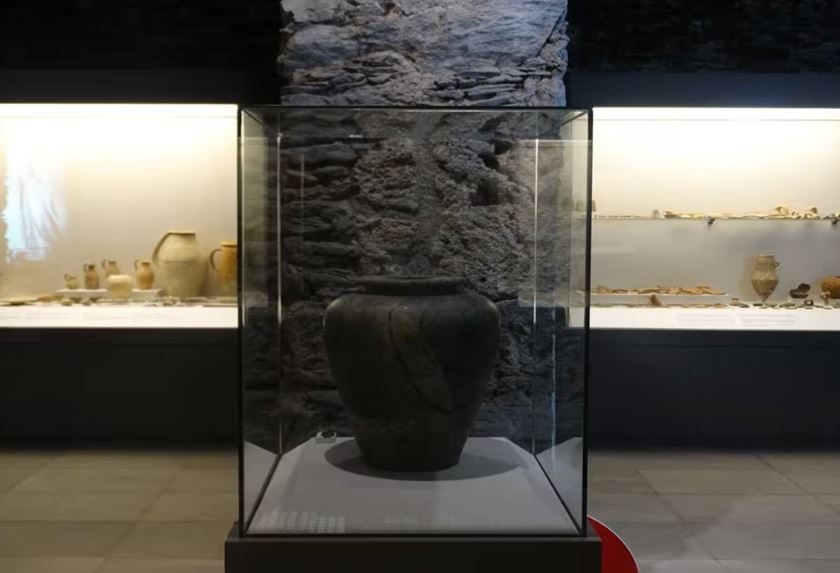
Beneath what was once a Roman temple dedicated to the goddess Minerva, this Roman cryptoporticus has been preserved and has housed the Municipal Archaeological Museum since 1984. The structure is exceptionally well preserved and represents an outstanding example of Roman engineering applied to urban development.
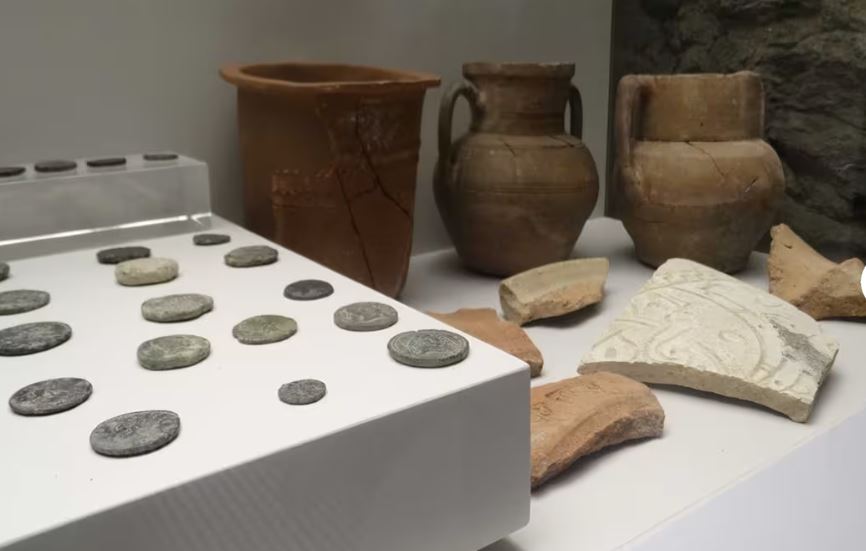
The museum offers an overview of Almuñécar’s history through eleven display cases containing artefacts from the many cultures that have inhabited the city over the centuries, from the Argaric period to the end of the Middle Ages. The collection includes items of Egyptian, Phoenician, Punic, Roman, and Andalusi origin, reflecting the strategic and commercial importance of this coastal settlement since ancient times.
A significant part of the collection comes from two key archaeological sites: the Roman necropolis of Puente de Noy and the El Majuelo salted-fish factory. Among the most notable objects are coins minted at the Sexi mint, Punic and Roman ceramics, alabaster vessels, jewellery from funerary grave goods, and important sculptures, including a representation of the goddess Minerva.
The museum’s most outstanding piece, due to its exceptional nature, is the canopic jar of Pharaoh Aauserre Apophis I. This Egyptian marble funerary vessel has been identified thanks to a hieroglyphic inscription on its upper section. Considered the oldest written document preserved in Spain, the jar may have arrived in Almuñécar with the Phoenicians around the 8th century BC, although it was manufactured several centuries earlier, between the late 17th and early 16th centuries BC. Its significance is such that it has been requested on loan by internationally renowned institutions, including the Metropolitan Museum of Art in New York.
Visiting Hours
Monday: Closed
Tuesday to Saturday:Spring (1 April – 30 June): 10:00 – 13:30 / 17:00 – 19:30
Summer (1 July – 15 September): 10:00 – 13:30 / 18:30 – 21:00
Autumn (16 September – 31 October): 10:00 – 13:30 / 17:00 – 19:30
Winter (1 November – 31 March): 10:00 – 13:30 / 16:00 – 18:30Sundays: 10:00 – 13:00
Admission Prices
Adults: €4
Children and pensioners: €2.50
Groups (minimum 15 people): €2 per person
The ticket includes admission to San Miguel Castle.
Address: Cueva de los Siete Palacios, calle Eras del Castillo 29, 18690, Almuñécar. Tel: 958 61 61 31. Email: culturalmunecar@almunecar.es