
- Home
- Business Directory
- Get the App
- Things To See & Do
- News
- Properties
- Event Guide
 ES
ES
Viewpoints and cliffs in Torrenueva Costa
Miradores y Acantilados de Torrenueva Costa (Viewpoints and cliffs)
The PR-A 420 “Miradores y Acantilados” trail is one of the most attractive hiking routes on the Costa Tropical of Granada. This circular route of approximately 10 km combines agricultural landscapes of subtropical crops with spectacular views of the cliffs overlooking the Alboran Sea. Thanks to its outstanding scenery and excellent signage, it was awarded Best Approved Trail in Spain in 2023.
It is a fairly accessible route. Apart from a short initial climb and a few gentle slopes along the cliff section, the trail is generally comfortable and pleasant to walk. Most of the route follows footpaths and trails, with occasional stretches of dirt track and small paved sections.
The route begins in Torrenueva Costa, at the eastern end of its seafront promenade. Parking is available in a large open area at the entrance to the town. From here, the walk starts through the village, passing Plaza Torre del Vigía, where you will find the Torre Atalaya, a defensive watchtower dating from the 17th–18th centuries, about 11 metres high, which gave the town its name.
After crossing the road, the route heads towards the Museo del Aljibe, an exhibition space located in a former water reservoir built in the early 20th century as part of the extension of the water channels coming from the Guadalfeo River.
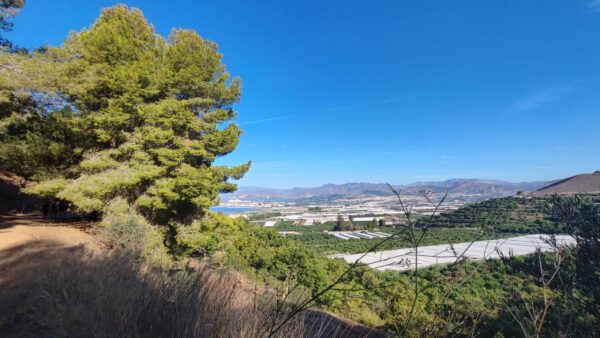
The path then continues towards Plaza Paterna, known for its long white wall decorated with numerous pots filled with colourful plants. From here the route follows Calle Mirador de la Bahía, soon leaving the asphalt behind to begin the ascent towards the first viewpoint. Along the way you pass through farmland dedicated to subtropical crops such as avocados, custard apples and mangoes.
After climbing a somewhat steep ramp, you reach the Mirador de la Bahía, a rest area equipped with benches and tables offering magnificent views of the coastline. A few metres further on, wooden signage indicates the direction to the Faro de Sacratif. A short detour leads to two natural viewpoints overlooking the landscape: Mirador Las Terrazas Bajo and Mirador Las Terrazas Alto, from where you can enjoy wide panoramas of the coast and the surrounding subtropical plantations.
Returning to the main trail, you pass an information panel about the PR-A 420 and reach the N-340 road, a section with historical significance. In 1937, this road was part of the tragic episode known as “La Desbandá”, when thousands of civilians fleeing from Málaga towards Almería during the Spanish Civil War were massacred by Francoist troops. The route crosses the road shortly before reaching the entrance to the Carchuna tunnel.
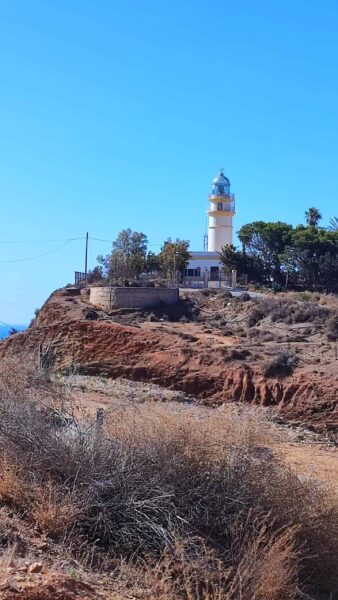
The trail then continues along a track leading to the Faro de Sacratif, located on the so-called Cerro del Chucho. This lighthouse was built in 1863 by engineer Constantino Germán on the remains of a 16th-century watchtower that collapsed after the 1803 earthquake. Standing 17 metres high with a focal height of 98 metres above sea level, it marks the southernmost point of the province of Granada, and its light reaches a large stretch of coastline between Cabo de Gata and Punta de la Mona.
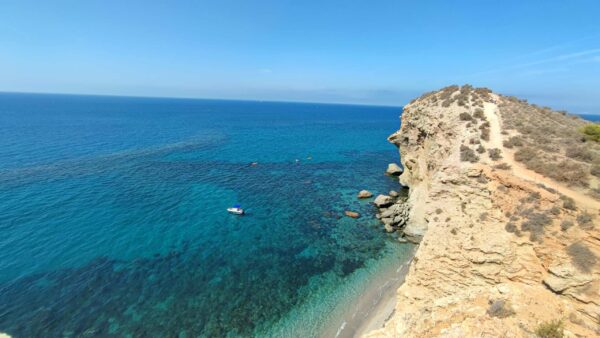
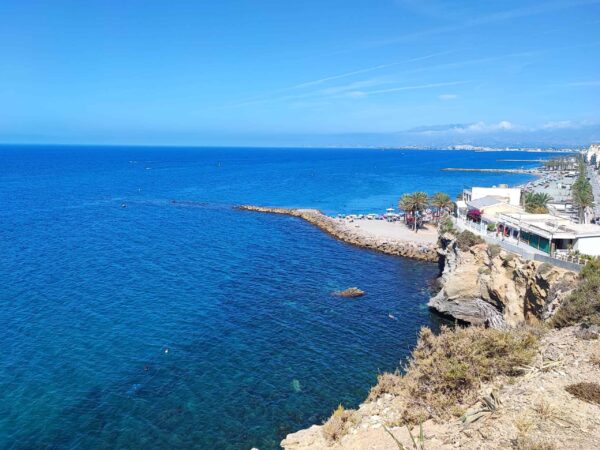
Walking around the lighthouse enclosure, you reach Cabo de Sacratif, where one of the most spectacular sections of the route begins. A coastal footpath runs along the clifftops, offering impressive views over Torrenueva and La Joya Beach, a small cove located at the base of the cliffs. In some sections the path is equipped with steel cables that serve as support and safety rails.
The trail continues with a series of small ascents and descents until reaching the stairs that lead down to La Joya Beach, where hikers can either descend to the shore or continue along the route towards the next viewpoint. After climbing another slope, you arrive at the Mirador del Hondurón, a large wooden viewing platform with sweeping views of this stretch of coastline.
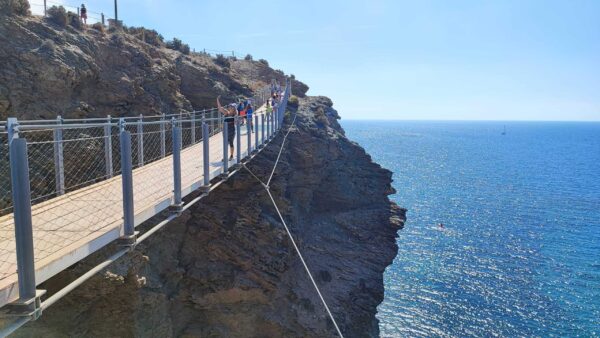
Soon afterwards comes one of the most distinctive features of the route: the Jolúcar Suspension Bridge. This 60-metre-long walkway, suspended by steel cables 32 metres above sea level, crosses the ravine separating the cliffs. In the central section, part of the wooden decking has been replaced with laminated glass flooring, adding an exciting touch to the crossing.
From here, the trail continues past the Mirador del Peñón de Jolúcar and reaches the Mirador de Nuestra Señora del Carmen, located at Punta Jolúcar. Finally, the route descends to the coastal promenade that leads back to the centre of Torrenueva, where this scenic trail—rich in landscapes, history and spectacular viewpoints over the Mediterranean—comes to an end.
Gallery




Costa Tropical App
With location-based recommendations and real-time alerts, it’s like having a tour guide in your pocket—so you never miss a thing!